What a hundred dollars buys, and what it does not
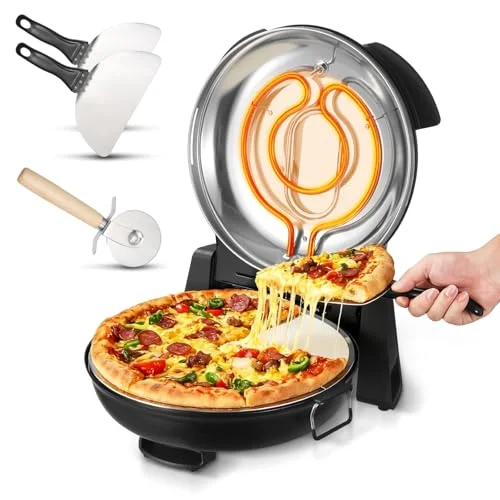
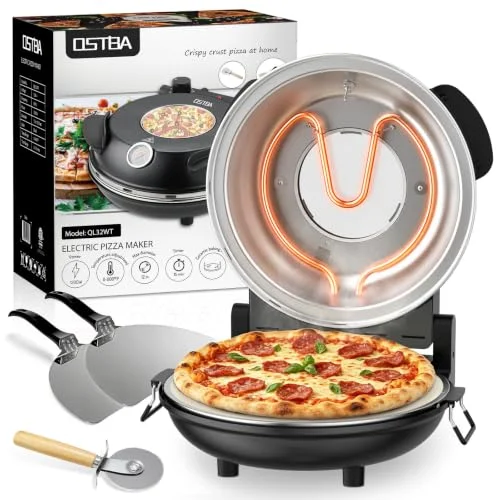
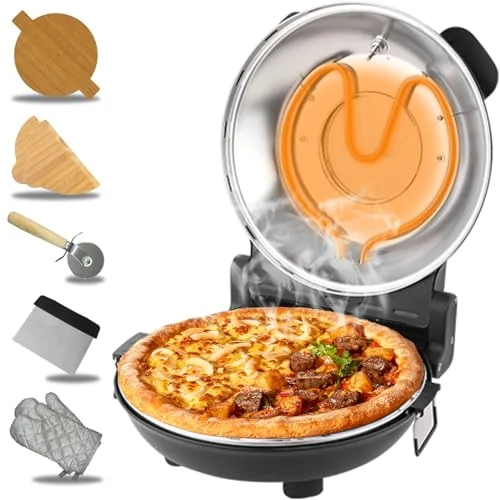
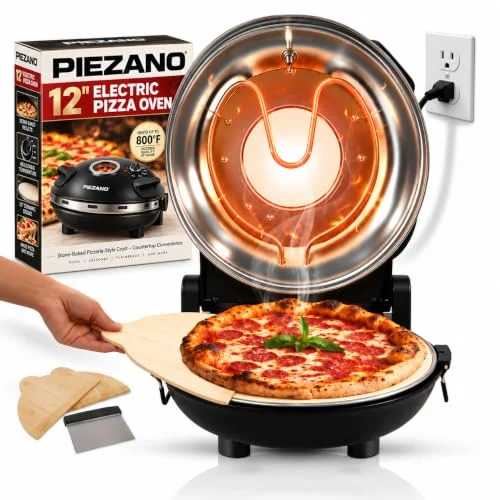
A hundred dollars buys the complete architecture of a real pizza oven: a stone the pizza actually sits on rather than a nonstick plate, a window so you can watch the bake instead of guessing, and two separate heating elements — one above the pizza, one below it — each on its own control. All four ovens compared here have those three things. What a hundred dollars does not reliably buy, in this bracket, is agreement on wattage: VEVOR and ECUMFFY both publish 1,200 watts, while OSTBA and PIEZANO don't state a wattage figure at all, which is common at this price since the number that sells a budget oven is the top temperature, not the watts behind it. It also doesn't buy you size — every oven here is built around a 12-inch pie — or a consistent accessory kit: two of the four list a peel and scraper included, two don't say. What the extra $10 to $30 across this bracket tends to buy, as the picks below show, is an accessory, a thermometer, or a stated cook time, not a fundamentally different oven.
Cordierite, ceramic or glazed: what the pizza sits on
The stone is the part of the oven actually touching your dough, and it matters more than the price tag does. Three of the four ovens here — OSTBA, ECUMFFY and PIEZANO — list a ceramic stone. VEVOR uses cordierite instead, the material most dedicated pizza stones are built from, chosen because it tolerates the fast temperature swing of a hot oven meeting a cold dough ball without cracking. Ceramic stones in this category do the same basic job: they store heat and pull moisture out of the base as the pizza bakes. A third material, glazed ceramic, turns up elsewhere in this market on trays and lower-heat countertop machines; the glaze seals the surface, which makes it easier to wipe clean but weaker at drawing moisture out of the crust. None of the four ovens compared here uses a glazed surface — all four are built around an unglazed stone, cordierite or ceramic, which is the right call for anything closer to pizzeria-style heat. Whichever stone you land on, let it cool fully before cleaning and scrape rather than scrub; a bare stone is porous and shouldn't be soaked.
Two knobs: learning the top-and-bottom balance
Every oven in this guide separates its heat into two zones, one element above the stone and one below it, and gives you a control for each rather than one dial that heats both together. That's the feature letting a $65 oven aim at a result a $500 oven also claims: run a hotter ceiling to brown the cheese on a thin pie, or a hotter floor to crisp the base under a loaded one, instead of accepting whatever single setting the oven defaults to. OSTBA calls its version dual controls; ECUMFFY and PIEZANO both call theirs dual or top-and-bottom heat controls; VEVOR's listing describes a five-mode temperature control, which we've treated elsewhere on this site as two knobs — one per element — each offering five settings, and that's the most useful way to read it here too. None of the four gives you a numeric degree setting on those knobs; what you get is a position, one through five, and a result you learn by watching through the window rather than by reading a number. A $700 oven with an adaptive control system makes that call for you in real time. These four hand you the two knobs and expect you to find the right combination over your first two or three pizzas.
1,200 watts, and what it means for the second pizza
A standard US kitchen outlet supplies about 1,800 watts, and nothing plugged into it alone can draw more than that regardless of price. Of the four ovens here, VEVOR and ECUMFFY both publish 1,200 watts; OSTBA and PIEZANO don't state a wattage, so we won't guess at theirs. Wattage doesn't set the ceiling temperature — insulation and time mostly do that — it sets how fast the stone gets its heat back after a cold pizza lands on it and pulls heat out on contact. Bake one pizza after a full preheat and 1,200 watts is plenty. Bake a second pizza right behind the first and 1,200 watts is the number that decides how long you wait, because the stone just gave up a chunk of its heat to the first pie and has to earn it back on the same 1,200 watts rather than a fresh preheat. None of these four is the oven to buy for five pizzas in a row at a party. For a weeknight pizza, or two pizzas a reasonable ten minutes apart, 1,200 watts on a 12-inch stone is enough, and it's the number both of this guide's two wattage-publishing ovens are built around.